
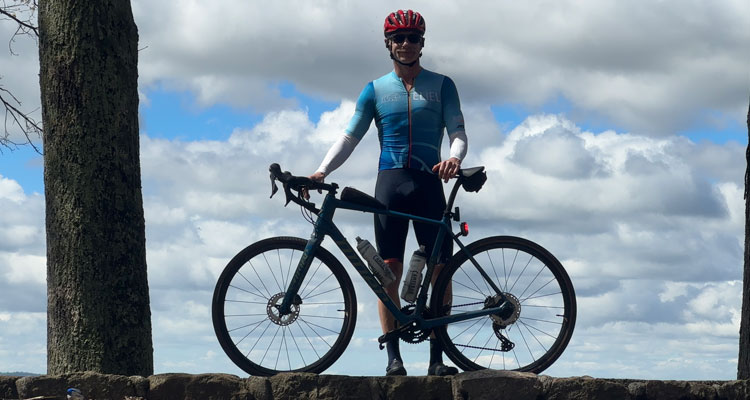
The alarm clock reads 3:30 AM, but Lee Sandstead is already wide awake in his mountain home in Virginia. While most of the world sleeps, he’s beginning what he calls his “thought work”—five to six hours of pure mental focus that fuel his dual passions for education and athletic performance. It’s a far cry from the galleries and museums where he once shared his love of Renaissance art with millions of PBS viewers.
The Unlikely Transformation
Ten years ago, if you had told the Travel Channel’s “Art Attack” host that he’d be living alone in the Virginia mountains with just a cat and a dog for company, coaching cyclists and transforming lives through nutrition, he would have questioned your sanity. After all, this was a man who had spent decades in the world’s great cities—Nashville, Memphis, New York—discussing Michelangelo and the Mona Lisa with television audiences across the globe.
“Thirty years ago, if you’d told me I’d be living by myself in the mountains, I would have questioned that supposition,” Sandstead says. “I’ve lived in amazing cities, and now I’m in the mountains of Virginia just rocking it out every day, talking to people through Zoom. It’s been an incredible journey.”
But perhaps the most incredible part of Sandstead’s story isn’t where he ended up—it’s how dramatically he had to transform himself to get there.
The Weight of Success
The transition wasn’t just professional; it was deeply personal. During his art history career, stress and the demanding lifestyle took a devastating toll. In just three years, Sandstead gained 100 pounds, reaching 250 on his 6’1″ frame. He was also battling what he openly acknowledges was a 25-year struggle with high-functioning alcoholism—a habit that began during his PhD studies in New York City.
“Everybody in New York City drinks,” he explains matter-of-factly. “You get your work done and then you go party. Every single day. You work hard. You party hard. Everything was about alcohol for me—weddings, dinners, finishing bike workouts. My friends to this day still can’t believe that I don’t drink.”
The turning point came in 2015, when the art world’s struggles during the economic downturn forced him to confront reality. Museums were cutting budgets, art departments were being slashed, and the field that had defined his identity was crumbling around him.
“Art departments are usually the lowest funded of university departments, and so much of that world was just wiped out,” he reflects. “By 2008 it became a real struggle for everybody in the art world. I really started questioning things.”
Finding Focus in the Mountains
Today, at 165 pounds and five and a half years sober, Sandstead embodies the transformation he preaches. His days begin in the pre-dawn darkness, not with coffee and newspapers, but with the kind of laser focus that once helped him photograph Michelangelo’s David from 10,000 different angles.
“Athletes are early morning people,” he explains, “and so I want to make sure everybody is up and running by 6 AM. Everything that I need for them is done, gone, dusted.”
His clients—ranging from weekend warriors to a 65-year-old competitor who just completed an 11-hour bike race in Spain—receive the same passionate attention to detail that once characterized his art historical research. Where he once traveled the world capturing images of Renaissance masterpieces, he now analyzes power data, heart rate zones, and testosterone levels with the same scholarly rigor.
The Art of Athletic Coaching
The parallels between his former and current careers aren’t lost on Sandstead. When he encounters a new athlete, he approaches them like a Renaissance painting—complex, layered, requiring careful study to understand all the elements at play.
“When I go to a museum and see an artwork, I’m asking myself a million different questions,” he explains. “The same process applies to athletes. When I get a new athlete, they’re very blurry, very foggy. The more questions I ask, the more they come into focus.”
This methodical approach extends to his educational philosophy. Where he once had to explain the subtleties of Caravaggio’s chiaroscuro technique, he now breaks down the complexities of lactate threshold training and sports nutrition. The content has changed, but the passion for teaching remains the same.
“I might have to learn 12 hours of content material to deliver a one-minute message to a client, but that’s the process and I love the education process,” he says.
The Athlete for Life Mission
Sandstead’s latest work-in-progress, a book called Athlete You, represents the culmination of his journey from art historian to performance coach. His central thesis challenges everything our sedentary culture assumes about aging and athletics.
“Modern day civilization is just destroying us physically,” he argues. “We’re indoors all day, not getting air, sun, or movement. I want people to consider themselves an athlete for life—find a sport, find a community, do events for the rest of your life.”
His oldest athlete is 65, regularly competing alongside men and women decades younger. The difference, Sandstead observes, isn’t just physical—it’s philosophical. While many Americans in their 50s and 60s require multiple medications, his athletes are “rocking it out at the highest level on zero medications.”
The Introvert’s Paradox
Perhaps the most surprising revelation about this high-energy coach and former television personality is that he’s actually an introvert at heart. The gregarious extrovert who once commanded sold-out museum lectures and Travel Channel audiences is, in his own words, “just really a quiet dude.”
“I would love it if I never had to do another social media post for the rest of my life,” he admits with characteristic honesty. “But I have all of these ideas in my head, and if I don’t kind of yell them, then they don’t get out. That message never gets out.”
It’s this combination of introversion and passionate mission that perhaps makes Sandstead so effective as both educator and coach. He understands the struggle of transformation because he’s lived it—not just once, but repeatedly throughout his unconventional career.
The Renaissance Continues
As Sandstead prepares for another mountain bike ride through the Virginia hills (after our interview, naturally), it’s clear that his Renaissance never really ended—it simply found new expression. Where he once helped people see the transformative power of great art, he now helps them discover the transformative power within themselves.
“Every journey of a thousand miles begins with one simple step,” he tells his clients, echoing the wisdom born from his own dramatic reinvention. “You spent a lifetime developing habits, and now we want to reverse those habits to make you the healthiest human being you can be.”
For a man who once gained 100 pounds and lost his way in alcohol, who watched his academic career crumble during the Great Recession, the view from his Virginia mountain home represents more than just a change of scenery. It represents proof that reinvention is possible at any age, and that sometimes the most profound transformations happen not in the world’s great museums, but in the quiet moments before dawn when we decide to become the artists of our own lives.
Lee Sandstead offers nutrition coaching and cycling coaching services through his practice. His book “Athlete You” is currently in development.