

It shouldn’t come as a surprise to anyone that Nick Roberts has found success crafting tales that shook one reader to write, “Not since William Peter Blatty’s The Exorcist have I been this terrified.”
Roberts is a native of St. Albans, West Virginia. In the paranormal community, St. Albans is home to one of the ghostliest places in the United States. The St. Albans sanatorium holds a tormented past, where the haunted history continues to relive itself today.
Roberts’ latest novel, The Exorcist’s House: Resurrection, brings to an end the trilogy of the bestselling series. But how does he write these stories that blur the lines between fiction and reality?
*Spoiler alert* It’s exactly the opposite of what you might expect from an author who spends his days conjuring nightmares.
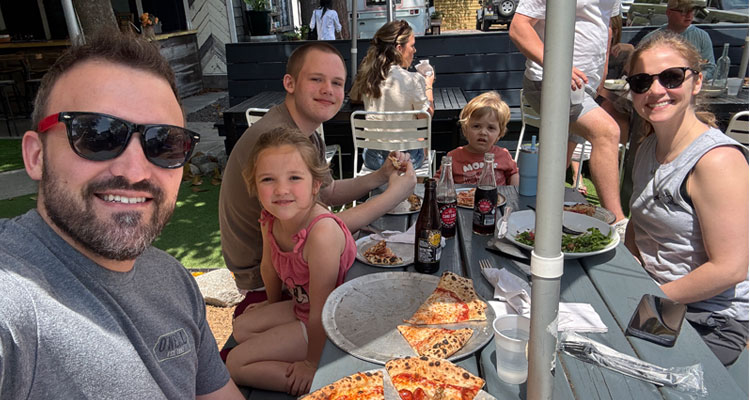
“I’m normally writing in the living room with my wife, kids, and animals existing in a whirlwind around me,” Roberts says. The contrast isn’t lost on him—creating tales of terror while surrounded by love and domestic bliss. But perhaps the understanding that darkness can seep into even the most ordinary moments makes his horror so effective.
The Long Road Home
Roberts’ path to becoming one of horror’s most compelling fresh voices wasn’t straight or easy. Although he now lives in South Carolina, he credits his link to St. Albans along with being born in October with instilling “a love for all things spooky.” Growing up in a household where creativity was celebrated led Roberts to storytelling. His mother, a lifelong educator, understood the power of books and imagination, filling their home with stories and possibility.
“She would not only read to me as a kid, but my parents had a bookshelf prominently displayed in our home,” Roberts recalls. “Looking back, I see how this normalized reading as a pastime for me—something I’m trying to continue with my children.”
From his earliest memories, Roberts was drawn to three things: reading, writing, and drawing. These creative outlets served as both entertainment and escape, though he wouldn’t understand their true importance until much later. As he entered his formative years, Roberts made “all the wrong life choices,” sliding down what he describes as “a dark path” of substance abuse.
“Even though I was struggling with substance use disorder, I still had that creative urge,” he reflects. That urge lay dormant for years, waiting for the right moment to burst free. That moment came in 2012, when Roberts made the decision that would change everything.
He went for treatment.
Rising from the Ashes
Sobriety saved Roberts’ life. It also unleashed his creative potential. After getting clean, he threw himself into education with the same intensity he once brought to self-destruction. He earned his BA in English, his MA in Teaching, and eventually his EdD in Leadership Studies. For seven years, he channeled his passion for storytelling into the classroom, working as an educator before making the leap to full-time writing in 2024.
“After I got sober, I went back to college,” he says. “That creative urge which finally burst through when I went to treatment—it had been waiting all those years.”
The transformation is inspirational. From addiction to advanced degrees, from darkness to dedicated family man and successful author. Roberts now lives with his wife and three children, having built the kind of stable, loving life that once seemed impossible.
Finding Fear in Familiar Places
Roberts’ horror is deeply rooted in the landscape of his youth. West Virginia’s reputation provides the backdrop for many of his tales, including his breakout novel The Exorcist’s House. When the book was published, readers and critics alike noted how the setting felt like a character in its own right.
“I realized how much I took the region for granted,” Roberts admits. “The rolling green hills typically associated with West Virginia are exotic to a lot of people. The state is also steeped in folklore. I just love the juxtaposition of horrible things happening in an idyllic setting.”
But Roberts is conscious of representing his home authentically. “It’s important to be authentic—layered—and not flee from stereotypes but put them under the microscope and see what’s really going on.”
This attention to place and authenticity extends to his preferred storytelling format. Something he calls “creepy chamber pieces.” Like a master of intimate horror, Roberts excels at confined spaces—cabins in the woods, haunted rooms, spaces where characters can’t escape whatever terror awaits them.
“Confined spaces are just easier for me as a storyteller,” he explains. “Once I’ve established the location, then I can take my little action figures and start making them do stuff. I’m a minimalist at heart. I also love dialogue and internal struggles. Throw in the embedded claustrophobia and suddenly you’ve got quite the pressure cooker.”
The Art of the Scare
Roberts’ list of influences reads like a horror hall of fame: Stephen King, Clive Barker, Bret Easton Ellis, Chuck Palahniuk, Stephen Graham Jones, Felix Blackwell, R.L. Stine, and Aron Beauregard. Each has contributed something essential to his creative DNA.
“R.L. Stine got me into reading with Goosebumps,which served as my gateway to Stephen King,” Roberts explains. King’s influence, he says, “can’t properly be expressed in words. His work ethic, passion for storytelling, and versatility provided the groundwork for career goals.”
Roberts continues, “I credit any scares readers have experienced with my books to Felix Blackwell. Reading Stolen Tongues motivated me to step up my creep factor.” But it’s not just about the scares. Roberts has taken something from each of his influences. Fearlessness from Clive Barker, authenticity from Stephen Graham Jones, the joy of the transgressive from Ellis and Palahniuk. Most importantly, he learned practical lessons about building a career from indie horror success Aron Beauregard, who “modeled how to write for a living as a self-published indie author.”
When crafting his own scares, Roberts relies heavily on sensory details. Something he ironically had to teach himself despite being an English teacher. “I would lecture about sensory language but fail to place much importance on it in my own work,” he admits. “Once I realized how effective evoking the senses was, it became second nature to me.”
The result is horror that gets under your skin. Readers often cite the prologue of his novel Mean Spirited as particularly effective, which Roberts attributes to his focus on sound above all other senses.
The Rhythm of Terror
Perhaps surprisingly for someone who creates such dark fiction, Roberts’ writing process is often accompanied by music—and not necessarily horror movie soundtracks. What started as a practical necessity to drown out household noise has evolved into an essential part of his creative process.
“Early on, the mood of the scene influenced the music choice because I needed it to stay in that mindset. I wrote the entirety of Mean Spirited to the Requiem for a Dream soundtrack,” he reveals. But a breakthrough came one exhausted night when he hit shuffle on his playlist instead. “Eminem gave me the energy I needed to power through a scene. The lyrics didn’t distract me, and they still don’t. Music is essential to my process, and it keeps evolving.”
Building Bridges in Horror
Roberts isn’t content to simply write. He’s actively building community within the horror genre. He runs a monthly Patreon flash fiction contest, organizes an annual award show through the Haunted Minds Book Club (a Facebook group he created), and regularly promotes other authors’ work.
“My favorite part of that is presenting the Legend of Literature Award,” he says. “Last year, I had the privilege of giving it to Stephen Graham Jones, and this year, it will be bestowed upon Joe Hill.”
As a hybrid author, Roberts splits his time between traditional publishing (he has a deal with Simon & Schuster’s audio division) and independent publishing. “I like to stay close to my readers and the indie horror community and maintain that diehard fanbase who’s been with me since day one,” he explains. “I also know there’s a ceiling in that world, and if I want to achieve my goals, I need to level up.”
Turning the Page
Roberts is entering what he calls “the end of an era,” having just completed the last installment in his Exorcist’s House/Anathema shared universe. Currently, he’s serializing a novel called My Corpse Has a Heartbeat on Patreon—his take on the first-person serial killer novel, inspired by America’s obsession with true crime.
“I anticipate this book pushing buttons and polarizing readers,” he says. “That’s good. You don’t always like what you see in the mirror.”
His audio novel Lyla, In the Flesh releases through Simon & Schuster in January 2026, and he’s working on a screenplay adaptation of his short story “Sally Under the Bed.” Hollywood has taken notice of both Mean Spirited and The Exorcist’s House, though Roberts understands the intricacies of film development. “I’m keeping expectations low until I’m in the theater.”
Light in the Darkness
For all the darkness in his fiction, Roberts’ real-life story is one of hope and redemption. His advice to aspiring horror writers is both practical and inspirational. “Read Stephen King’s On Writing, silence the imposter syndrome, and write daily. Your voice will naturally emerge.”
But perhaps more importantly, Roberts uses his platform to share his story of recovery. “I will continue to put the work in, help others when I can, and always share my personal story of recovery because there are millions of people out there struggling with addiction, thinking a joyous life without drugs and alcohol is as fictional as the stories I write, and that couldn’t be further from the truth.”
It’s this combination—the man who found his way out of personal darkness and now creates fictional darkness for others to safely explore—that makes Nick Roberts such a compelling figure in contemporary horror. He understands that sometimes we need to visit dark places in fiction to appreciate the light in our real lives.
“Even though I write about the darkness,” Roberts says, “the future looks bright.”
For more information about what Nick Roberts is working on, visit https://www.nickrobertsauthor.com/