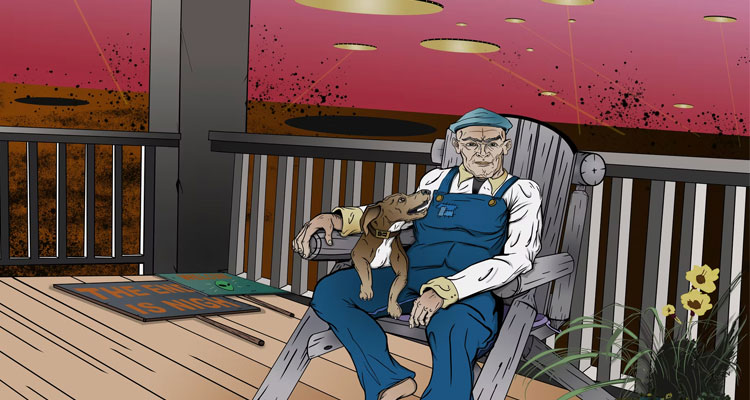


There is a painting that Kris Saintsing made during the early weeks of the COVID-19 pandemic that tells you nearly everything you need to know about how he sees the world. In it, an older man sits quietly on his front porch while flying saucers tear apart the landscape behind him. The sky is catastrophic. The man is still. The title is Ma, the Invaders are Terraforming.
At nearly five-feet wide, the painting is designed to overwhelm. It captures a particular feeling that many people recognized in 2020 but struggled to name: the bizarre, vertiginous sensation of watching global collapse from an ordinary porch, in an ordinary town, while the birds still sing. Saintsing had just returned to his hometown in North Carolina after fifteen years in Los Angeles. He was self-quarantining in a rented house, surrounded by the rustic landscape of his childhood, while the world came apart on every screen.
“The combination of being back in my hometown while everything felt so chaotic,” he says, “produced that image.”
That capacity for finding the personal within the apocalyptic is at the heart of Saintsing’s work. He is a fine artist and professional illustrator who operates under the banner of Big Ancient Studios, and his visual language draws heavily from science fiction, fantasy, and horror. Not as genre exercises, but as psychological tools. “These genres allow inner states to become tangible,” he explains. In his piece The Android in Diagnostic Mode, a malfunctioning robot stands in for the artist’s own anxiety: the trapped, helpless sensation of existing inside a system that isn’t working and urgently needs repair.
Saintsing has been using art as emotional infrastructure since childhood. He describes himself as a kid with “fairly severe anxiety issues” for whom making art was less a hobby than a survival strategy. A way to process fear, dreams, and internal conflict that had no other outlet. That foundation became a professional decision in college, where he pursued Film & Television as his major and Studio Art as a minor, a deliberate dual commitment that would come to define his entire career.
The television career that followed was formidable by any measure. Saintsing spent nearly two decades in post-production, rising to supervise editing, visual effects, color, music, and sound on series including The Walking Dead, Torchwood, and The Muppets Mayhem for networks like ABC-Disney, Warner Bros., and Lionsgate. Before that, he was writing, directing, editing, and animating viral comedy content for National Lampoon in the early 2000s. Saintsing was a one-man creative operation that prefigured the kind of multi-hyphenate work he would later practice in fine art.
It was during his time at Warner Bros. that a specific visual ambition crystallized. Walking the studio hallways, he regularly encountered framed original cels from Looney Tunes and Batman: The Animated Series. Something about the artwork drew him in. “They just had so much depth and pop,” Saintsing says. He realized that’s what he wanted his own work to look like: large-scale versions of animation cels, rich and luminous, with light moving through them. He developed a method to achieve it, beginning each piece as a pencil drawing on paper, scanning it at extremely high resolution, then digitally painting the final image in Photoshop while deliberately preserving every imperfection from the original. The pieces are then output as large, transparent prints. When light passes through them, the arresting effect is dimensional, glowing, and alive.
“I approach this stage the way one would master a song,” Saintsing says. “Making refinements while preserving the soul of the piece.”
About ten years ago, he made a conscious choice to return to making standalone fine art alongside his production work. Pieces that existed for their own sake, not in service of a pipeline. It was not a rejection of television, but an expansion. The years spent sharpening images for clarity, emotional impact, and storytelling precision had left a deep mark. “My television background fundamentally shaped how I approach fine art.”
His influences form an eclectic constellation: pop-surrealists like Takashi Murakami, David Choe, H. R. Giger, and Mark Ryden sit alongside classic comics artists like Wally Wood, Al Williamson, and Frank Frazetta. Beneath all of them runs the deeper grammar of cinema, animation, video games, and television. The visual culture that shaped him long before he could articulate why.
Community has also been central to Saintsing’s development as an artist, though it arrived later than the work itself. He spent several years making art privately before a group of co-workers — while he was post-producing Greenleaf for the Oprah Winfrey Network — pushed him to visit the Downtown LA Art Walk. That visit led him to The Hive Gallery & Studios, a sprawling, genre-driven co-op, where he secured his first exhibition space. Even after relocating back to North Carolina during the pandemic, he maintained his presence at The Hive remotely. He later joined Artmongerz, a co-op in Greensboro, North Carolina, that he credits with significantly broadening his perspective.
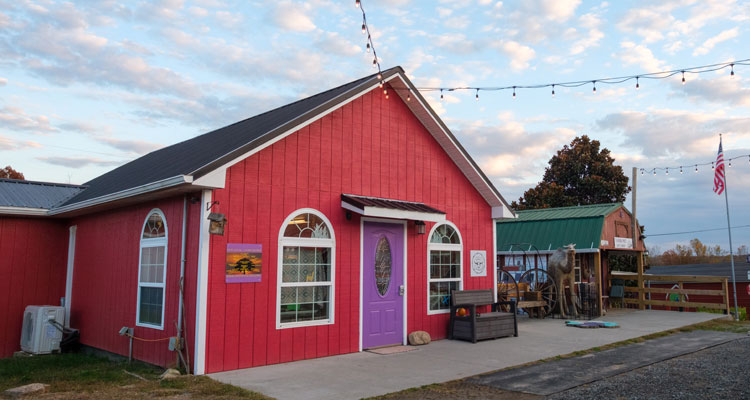
Today, much of that community-building energy flows through his curatorial work at The Brewer’s Kettle in High Point, North Carolina, where he has organized monthly exhibitions and events for nearly five years. “Building community is foundational to my practice.” It’s clear Saintsing means it structurally, not decoratively.
In recent years, Saintsing’s practice has shifted further toward physical media — pencil, ink, charcoal, acrylic, layered spray paint on glass — often working entirely in grayscale. He attributes the rise of AI image generation to accelerating the shift. “It pushed me to double down on physical media,” he says. “That return to fundamentals has been deeply rewarding.” For an artist whose career began with digital tools and television pipelines, the move feels less like a retreat than a recalibration: a reassertion of the handmade, the imperfect, the irreducibly human.
Looking ahead, Saintsing has several projects taking shape simultaneously. For him, it’s the only way to work. He and his wife, Pam, are developing an assemblage art exhibition inspired by a 2024 trip to Joshua Tree, where they encountered massive outdoor galleries of sculpture made from reclaimed materials. He’s also building a new body of work rooted in classic film noir of the 1940s and ’50s: still cinematic, still psychological, but filtered through a darker and more shadowed lens.
Meanwhile, at The Brewer’s Kettle, the community he has spent years building continues to grow.
The man on the porch keeps watching the sky. And Kris Saintsing keeps painting it.
To see more of Saintsing’s work visit krissaintsingillustration.com/portfolio